In both Czechoslavakia and Yugoslavia- there was a mix of people that belonged to different races, traditions, etc... but there was still a lack of toleration. Ethnic tension that had been suppressed by "centralized communist governments" returned and racial violence continued throughout Eastern Europe (1044). As I keep reading, I learn that even more ethnic cleansing occurred when the Serbs forced hundreds of thousands of Albanians from their homes in 1999. 1999 was during my lifetime- that is what scares me. THIS IS STILL HAPPENING?
Wednesday, April 22, 2009
This is still happening?
I just want to say that i am appalled by what i am reading in the textbook, "The Serbs and Croats, both of whom disliked the Muslim Bosnians, were especially well equipped and organized. They rained shells and bullets on towns and villages, burned houses with families inside, imprisoned Muslim men in detention camps and starved them to death, and raped thousands of Bosnian women. All sides committed atrocities. The Serbs...carried out the worst crimes. these included what came to be called ethnic cleansing... campaigns of murder and terror" (1044). SERIOUSLY? I would've thought that by now, people would've learned to stop all this ethnic cleansing. After learning about the holocaust and all the anti-semitism- I had hoped that as I continued to learn more about the history of Europe and of the world i would learn that man is better than this: better than killing someone just because he/she is different. I know that may sound cliché or corny or whatever, but it is honestly what I am thinking and feeling. I am outraged by reading of the horrors of mankind. Maybe I am just snapping right now because it's hard to learn about the history of Europe and see just how horrible (and obviously how great) man can be. But truly, those people that did "ethnic cleansing" are showing that their true essence (existentialism) is EVIL.

Friday, April 17, 2009
Solidarity in Poland!
The textbook talks about how polish workers in 1980 organized strikes and laid out several key demands: "first, they objected to working conditions imposed by the government to combat a severe economic crisis. Second, they protested high prices and, especially shortages, both of which had roots in government policy and priorities. Above all, though, the Polish workers in Solidarity demanded truly independent labor unions instead of labor organizations sponsored by the government" (1039). By questioning high prices, working conditions, and the basis of the structure of the labor unions- the workers were questioning the socialist government- and therefore questioning communism as a whole. This clearly angered the mother country of the Soviet Union. The Soviet response was that this solidarity movement (lead by Lech Walesa) was the "growth of anti-sovietism in Poland" and that this aroused hatred among poles towards the Soviet Union and Soviet people and to go even further, the response said that this meant "to break the bonds of fraternal friendship linking our peoples and as a result to tear Poland from the socialist community and to liquidate socialism in Poland." I found this to be EXTREME- but I guess that if the Soviets didn't overreact, then Poland might drop out of theWarsaw Pact and be lost to democracy forever and ever. This website claims that "Solidarity was an independent labour union instrumental in the eventual collapse of the Soviet Union, and the primary catalyst that would transform Poland from a repressive communist satellite to the EU member democracy it is today." In my opinion, I am happy that Poland is now a democracy today and no longer a communist state.
In most of these documents, something that i found interesting was that the communists in the Soviet Union had a very strong fear of this anti-soviet power building up in Poland, and it reminded me a little bit of the fear of communism that took hold of western europe and the United States in particular (which in turn lead to the concept of containment). I guess you are always afraid of THE OTHER!
Something else that I noticed was the brilliant diplomacy of Wojciech Jaruzelski's Announcement of Martial Law in Poland. I just liked how he announced that the soviet union would be bringing in their army into Poland for the "sole task of the protection of legal order in the country and the creation of executive guarantees that will make it possible to restore order and discipline." I just think that Wojciech was able to please the people of Poland and the Soviets by mentioning the "Polish-Soviet alliance...which will remain, the cornerstone of the Polish raison d'etat, the guarantee of the inviolability of our borders." Of course Wojciech did have to repress Solidarity itself.
All in all, I feel as though this incident in Poland was mainly just one of the factors that caused the collapse of communism.
Zak and Grace...now back to our discussion!
Okay, so basically GROUP- i figured since our conversation has died in the past couple weeks and neither of you answered the questions i posed in my last post- i'll bring our conversation back to the root of our debate: totalitarianism. You guys should check out this website because it compares a totalitarian regime and a dictatorship once again showing that a totalitarian regime wants TOTAL control, and not merely political control and the tot. regime is usually lead by a "charismatic leader," in Germany's situation that charismatic leader would be Mr. Adolf Hitler. This video, Hitler spoke with great conviction the words, "germany will be revenged, a new and greater reich will rise form the ashes, every german will have a job and bread." The masses responded in favor of this man who had a "stronger will" than the rest of the people. Maybe I have mentioned this before, but i am certain that cas has talked about this in class- that Rousseau's concept of the general will, played a big role in the coming about of the Totalitarian state. Wikipedia says that " Jacob Talmon characterized Rousseau's "general will" as leading to a Totalitarian Democracy because, Talmon argued, the state subjected its citizens to the supposedly infallible will of the tyranny of the majority." If I am not mistaken, with the concept of the general will, if the people were unhappy with the way they were being lead, they could uproot the leaders and rule the country with a better general will. Hitler certainly uprooted Germany, took control (even if he was democratically elected), and made the citizens follow this supposed "infallible will of the tyranny of the majority."
So now that i've proposed this link between Rousseau's general will and Hitler's totalitarian state- do either of you guys agree with me or disagree with me? Perhaps you can think back to another philosopher from the enlightenment that influenced the coming of the totalitarian state? ANY NEW IDEAS?
Monday, April 13, 2009
The Three Fates
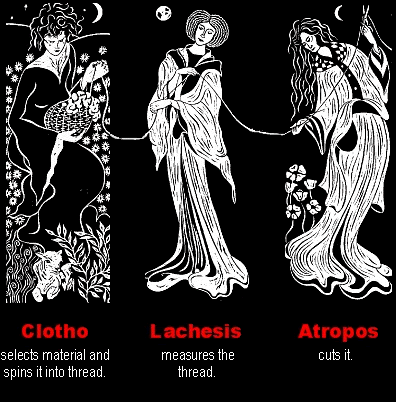
To be perfectly honest, I'm having trouble grasping what existentialism truly is. JED talks about how existentialism usually questions humanity's existence, but i found that on this website existentialism is defined as a philosophy that "assumes that people are entirely free and thus responsible for what they make of themselves". This certainly combats the previous concepts of free will and pre-determination. Also- ideas about fate and how we never can be in charge of our own choices since it is also planned out for us by fate. Who knows, maybe the three fates do exist and they are weaving our lives together with a bunch of colorful threads. Our lives and deaths are in their hands. Unlikely, but in my mind, not completely impossible. But more on that definition that I found, I like the part about how people are responsible for what they make of themselves- this is definitely true. Just like how Sysiphus makes his own conscious choices and is responsible for his own actions and therefore for his own punishment of being forced to push this rock up the hill forever and ever and all of eternity! His is also conscious of his fate when he watches the rock roll back down the hill. I found this part about what Camus was saying absolutely fascinating: "he is superior to his fate. he is stronger than his rock. if this myth is tragic, that is because its hero is conscious." This may seem random, but this concept of how it is tragic because he understands and is conscious of his ever-lasting fate, reminds me of this story that we read in spanish called San Manuel Bueno Mártir where it talked about la cruz del nacimiento (literally: the cross of birth). Basically, our original sin of being born makes life tragic if we are conscious of this fact because we will always go through life knowing that we can never escape sin. It's connected because of this concept of being conscious of our punishment or our sin- therefore making life tragic. Granted, this is just my opinion. The rest of what Camus was talking about definitely went over my head a little bit... Something about Absurdism and happiness being "two sons of the same earth." What does that even mean??
Thursday, April 2, 2009
Oh Sweden!
SWEDEN IS RIDICULOUS! I had no idea that Sweden is so focused on this "antisecrecy model" where tax returns are public documents. I found that entire second article on how more people lost their chances at being government officials due to problems with taxes than with extramarital affairs: "democrat Gary Hart lost his bid for the U.S. presidency in 1988 after admitting to an extramarital affair" VERSUS "social democrat Mona Sahlin lost her shot at the swedish prime minister's post seven years later after acknowledging she used her government cash card to buy 600 kronor worth of chocolate, diapers, and perfume." I mean TAXES vs. AFFAIRS- to me it just seems that having an affair is a sign of disloyalty to one's spouse and perhaps even to one's country, but a small, probably accidental, cheat on one's taxes is just a sign of stupidity or the human race's lack of perfection.
Also, I was very surprised at how everyone has "free access to official documents" and how children are regarded as full citizens who not only have the right to know their true father, but their opinion can also play a part in the divorce. I just don't agree with this because children are too young to know what is best for them and kids under 18 should not be able to make some decisions just because they are considered "full citizens." I mean, also the whole law on corporal punishment- how spanking is illegal- a little ridiculous. I mean spanking is bad- but there shouldn't be a LAW against it. That's one step too far. How is this concept so idealistic? I mean sweden is very open with communication and trust for sure. Everyone has a say in the community and there isn't really much of a PRIVATE LIFE. Therefore it is a very communitarian society where the only sense of individualism is "the island, the archipelago, and the sailboat" and the only sense of deviant behavior in swedish society is with violence, alcoholism, and drugs. I guess, i just don't really see the appeal to having no private life and no ability to converse because people in Sweden "never raise their voices and rarely gesticulate" (especially since gesticulation is a skill and hobby of mine!)
Wednesday, April 1, 2009
Why didn't we blow ourselves up during the Cold War?
After completing that simulation today in class- it's hard to see why we didn't blow ourselves up. The USSR gave us an ultimatum that we didn't want to follow or abide by, so we went against their wishes but i didn't actually think they'd blow us up. I mean, I honestly wanted to blow them up too, but this is just a game: not the real thing. I definitely couldn't live with knowing that I killed MILLIONS of people with the push of a button. They had a partial victory and we had total defeat: okay, i can live with that. I realize my team didn't save the United States, but at least we didn't succumb to their level and resort to blowing things up in order to get their way. That's one of the reasons I think we didn't all blow the world up- it's because no one wanted to be the first to strike, no one wanted to be blamed for the war. If the USSR shot first, then we could counterattack and blame all the destruction on the evil communists. BUT if we struck first than all the blame would be on us. We would be blamed for all the destruction and deaths in the USSR and the US citizens (that would still be alive) would find it hard to blame the USSR for something that they didn't even start. It's just like in any fight, both sides want to win and blow stuff up, but no one also wants to strike first. It's partially about fear as well, fear of what exactly would happen if we pushed the button and nuked the world. I know they all saw what happened in Nagasaki and Hiroshima, but that's Asia- what exactly would our home country, the USA, look like if most of it was ruins, ruins, and more ruins covered in nuclear radiation? Therefore, I think that we didn't blow ourselves up during the Cold War because we were scared of what would happen and we didn't want to be blamed for the destruction of the world. I mean, who would want that kind of guilt? the guilt of killing millions! DAVID JONATHAN AND NATE! YOU KILLED MILLIONS/you destroyed the USA! OH WELL!
Sunday, March 29, 2009
Division and Destruction
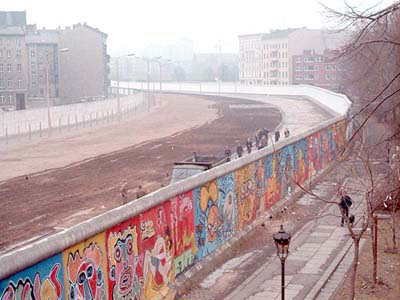
For me, this section of the reading is symbolized by the Berlin Wall. Division between East and West Germany. Division between East and West Berlin. Division between the USA (West) and the Soviet Union (East). It just seems to me that the rift between those that support communism and those that support democracy has gotten so much bigger after the war ended. "The nuclearization of warfare fed into the polarizing effect of the cold war, for countries without nuclear arms found it difficult to avoid joining either the Soviet or American pact" (987). Basically, the smaller countries without the H-bomb were forced to take sides and help fight against "the others." That phrase in the textbook: "to defend family and home against the menacing other" reminds me of LOST. Anyways... Everyone was almost forced to take sides: as shown by the creation of both NATO and the Warsaw Pact of 1955. The democracies around the world formed NATO and the USA led the way against communism with the Marshall Plan (provide military assistance to anticommunists) and the Truman Doctrine (support the resistance of "free peoples" to communism" (985)). Basically, I just felt that the world was divided even more than it was during the war. COMMUNISM VS DEMOCRACY.
"It seemed to confirm both humanity's power and its vulnerability" (987). This statement is true just because with technology and power comes responsibility. Even though I am an American, I don't agree with the US's decision to drop the atom bomb on Hiroshima or Nagasaki. It is horrible the amount of innocent lives that were destroyed in just a few seconds. That is a scary thought- that humans hold the power to destroy all of humanity. One push of a button and we are all wiped out. BAM! TOTAL DESTRUCTION!
Subscribe to:
Posts (Atom)